
THE REPUBLIC IN FREEFALL: HOW A PARTY’S RETREAT FROM PRINCIPLE IS DISMANTLING AMERICAN DEMOCRACY
The spectacle now unfolding in the Republican Party is not mere factional squabbling. It is the slow-motion performance of institutional suicide, and the world is watching as the last superpower rehearses its own decline. When Donald Trump Jr. celebrates the exodus of a dozen Heritage Foundation scholars to Mike Pence's Advancing American Freedom as "great news,"
Declaring that anyone departing Heritage for what he dismisses as a "globalist Never Trump organization" is unfit to claim the mantle of patriotism, he articulates a governing principle that has toppled every great republic in history: the conviction that loyalty to a person matters more than fidelity to principles, institutions, or constitutional order.
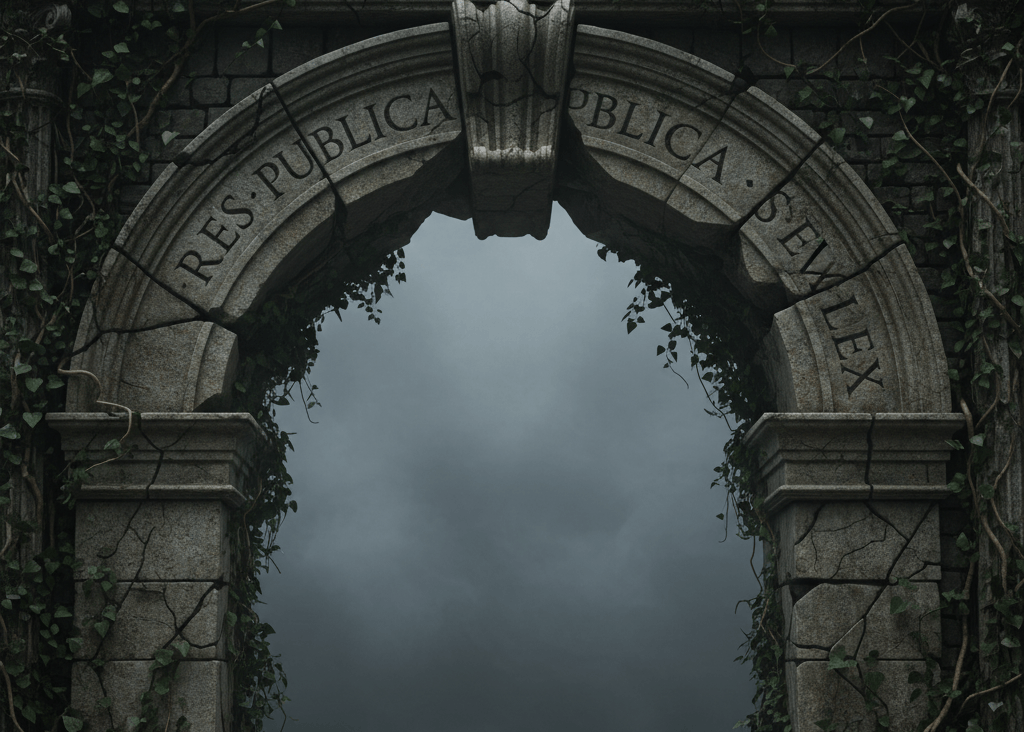
This moment, when influential conservatives like Robert P. George—described by the New York Times as America's most influential conservative Christian intellectual—are excoriated as traitors for seeking refuge in institutional conservatism, recalls the most dangerous passages of republican history.
The Roman historian Tacitus, writing in the second century AD as he surveyed the wreckage of a once-great republic, lamented with prophetic precision: "Lust of absolute power is more burning than all the passions." He watched as senators became courtiers, as dissent became sedition, as the Senate itself—once the forum of republican virtue—became a stage set for the ambitions of men who measured patriotism not by what they built but by their capacity to destroy rivals.
Tacitus understood something that American conservatives once held dear and are now abandoning: that a republic dies not in cataclysm but through the erosion of norms, the militarization of party politics, and the reduction of civic loyalty to personal fealty.

THE HOLLOW FORTRESS
The Heritage Foundation, once the intellectual fortress of American conservatism, now finds itself hollowed from within. When board members Abby Spencer Moffat—a trustee since 1992 with deep family ties to the institution—and Shane McCullar resigned within days of each other in December 2025, they did not storm out in anger; they departed with the solemn gravity of physicians abandoning a patient they could no longer treat. Moffat, CEO of the Diana Spencer Foundation, articulated the diagnosis with surgical precision: "When an organization hesitates to address harmful ideologies and permits poor judgments to persist, it relinquishes the moral authority essential for its influence. I cannot continue to serve on a board that is either unwilling or incapable of addressing this moment with the necessary clarity and bravery." McCullar was equally unsparing: "No organization that hesitates to denounce antisemitism and hatred or provides a platform for those who propagate such ideologies can genuinely claim to uphold the vision that once established the Heritage Foundation as the most esteemed conservative think tank in the world."
These were not liberal apostasies; these were the laments of conservatives watching the defeat of conservatism itself. And their departure was greeted not with introspection but with mockery from the party's new enforcers. This is what Montesquieu warned about in his analysis of republicanism: the corruption of democratic institutions proceeds not through external conquest but through the displacement of virtue by ambition. In The Spirit of the Laws, the French political philosopher insisted that "a republic requires virtue," meaning the "consistent preference for the public good over private interest," a quality he likened to "the vows of monks to God." When virtue is banished, he cautioned, "ambition invades the minds of those who are disposed to receive it, and avarice possesses the whole community. The members of the commonwealth riot on the public spoils, and its strength is only the power of a few, and the license of many."
This is the Republican Party in 2025. What was once driven by articulated ideas about limited government, constitutional restraint, free markets, and the rule of law has curdled into a cult of personality in which institutional survival is measured by proximity to a single figure and ideological purity is tested through displays of vendetta against the insufficiently loyal. The architects of this transformation—from the Tea Party insurgency of 2009 onwards through Trump's ascendancy—have succeeded brilliantly in one regard: they have torn down the guardrails of party discipline, primary selection by establishment gatekeepers, and coalition building across ideological factions. What they have not yet acknowledged is that these guardrails existed for a reason.
Political scientists at the University of Akron have documented the transformation with clinical precision: "The Republican Party entered the Trump era already hollowed out as an institution. Its national and state organizations had lost control over nominations, messaging, and fundraising to outside groups—Super PACs, ideological media outlets, and donor networks. By the time Trump appeared, the GOP was less a coherent political organization than a brand available for capture by whoever could dominate the news cycle and rally the base." This institutional fragility is now manifest in the present moment: a party that captured power through the demolition of norms now lacks the institutional capacity to govern or to propagate its own political program beyond the tenure of its current strongman.

THE AMERICAN WAY AND ITS BETRAYAL
The deeper question, however, goes to the heart of what the Republican Party was supposed to represent. For those of us who came to conservatism not as a tribal inheritance but as a conscious intellectual choice—who selected the Republican Party as the library of our political philosophy and the arena for our civic action precisely because it stood for the subordination of faction to principle, the rule of law over the rule of men, and the Constitution as the source of legitimate authority—the present moment is not merely disappointing. It is a betrayal of the foundational premise upon which we pledged our allegiance. The American way, at its best, has always embraced a paradox: the freedom to accumulate wealth, to build enterprises that span continents, to pursue prosperity through global engagement—all of these are hallmarks of American capitalism and the dynamism it unleashes. Yet this freedom was always meant to be constrained by law, by custom, and most crucially by the principle that no person stands above the legal order itself. The Founders understood that ambitious men would seek power; they built institutions to ensure that ambition would be channeled, constrained, and ultimately subordinated to the Constitution.
What is now occurring within the Republican Party is the abandonment of that very principle. It is the assertion that loyalty to a man matters more than loyalty to law, that power deployed for factional advantage trumps the health of institutions, and that vindictive purges of ideological dissenters strengthen rather than weaken the republic. This represents not the apotheosis of American capitalism or conservative governance, but its inversion. That American enterprises engage globally, that they deploy brand licensing and capital flows across continents, is simply the reality of commercial endeavor in the twenty-first century and reflects nothing so much as American entrepreneurial genius. But there exists a categorical difference between conducting business globally and allowing business interests to become the governing logic of the state itself. A republic can tolerate capitalists; it cannot survive the fusion of capitalist power with state power, particularly when that fusion is justified through an ideology of personal loyalty rather than constitutional principle.
Yet here we arrive at the central paradox that haunts the present moment. The denunciations of "globalists" and the celebration of institutional exodus represent something more than mere contradiction. They represent the collapse of any meaningful distinction between the interests of one enterprise and the interests of the party itself. When the departure of serious conservatives is greeted not with concern but with schadenfreude, when institutional independence is viewed as disloyalty, when the only remaining test of patriotism is willingness to subordinate principle to personality—the party has already ceased to be a vehicle for conservatism. It has become something else entirely: a mechanism for the concentration of power and the elimination of internal resistance to that concentration.
THE COLLAPSE OF INSTITUTIONAL RESISTANCE
The historian Niccolò Machiavelli understood this dynamic, though he did not articulate it with the clarity of the Romans he studied. Tacitus, watching the Senate become irrelevant under the emperors, observed with bitter precision: "When men of talents are punished, authority is strengthened." The corollary is equally true: when men of talents are driven out and replaced by loyalists, authority weakens catastrophically. The Roman Republic did not fall because it lacked ambitious men; it fell because it lacked institutions capable of restraining ambition, and because its political class ultimately abandoned the principle that the constitution itself was worth defending more fiercely than any factional victory.
The Republican Party's internal dynamic now follows a pattern that historical analysis identifies as the terminal phase of institutional decay. Edward Gibbon, the great historian of Rome's decline, identified a cascade of failures: the politicization of the military, the replacement of merit with loyalty, the substitution of written law with the arbitrary will of powerful men, the erosion of civic virtue, and finally—most damningly—the loss of elites' capacity to restrain their own ambitions in service of the common good. The parallel is not perfect, but it is unmistakable. The Republican Party has lost control over its nominating process to a single figure who demands loyalty above all. It has gutted its own institutional gatekeepers, leaving no mechanism to prevent the ascent of demagogues or the expulsion of dissenters. It has constructed a parallel media ecosystem that operates as a propaganda apparatus rather than a forum for genuine debate. And it has increasingly adopted an ideology that, in the words of Mike Pence's former chief of staff Marc Short, "promotes rule of man over rule of law."
What is most striking about the Heritage Foundation episode is that it reveals the degree to which the party leadership is committed to the purge itself. When Pence's organization welcomed more than a dozen Heritage scholars, offering them resources and a platform to articulate traditional conservative ideas, the appropriate response would have been introspection: Why are our most respected thinkers leaving? What are we doing wrong? What principles have we abandoned? Instead, the response was triumphal mockery. Heritage's new leadership, aligned with the Trump project, chose acceleration over reflection. E.J. Antoni, Trump's economic appointee, was elevated to leadership within Heritage precisely because he represents the merger of the think tank with the Trump administration—institutional capture rather than institutional independence. This is the logic of every failing autocracy: the ruler, insecure in his legitimacy, installs loyalists in positions of authority, purges dissidents, and interprets the resulting institutional weakness as evidence of strength.
James Madison, in Federalist No. 10, warned that when a faction becomes a majority and captures the apparatus of popular government, "the form of popular government enables it to sacrifice to its ruling passion or interest, both the public good and the rights of other citizens." Madison believed that a large republic, with its multiplicity of interests and factions, would prevent any single faction from consolidating permanent control. What he did not anticipate was a technology—social media—that would allow a single faction to dominate the news cycle, shape messaging, and enforce ideological conformity across geographically dispersed populations with unprecedented speed. Nor did he anticipate the hollowing of party institutions themselves, which left no internal mechanism to resist capture by a populist outsider once the guardrails had been demolished by the Tea Party and other insurgent movements.

THE NATURE OF ACTUAL CONSERVATISM
Mike Pence's Advancing American Freedom represents something increasingly rare in contemporary American politics: a vehicle for traditional conservatism, defined by limited government, free trade with free nations, the rule of law, and support for America's traditional alliances, including Ukraine and Israel. Pence explicitly rejected what he called "unprincipled populism"—the ideology that measures patriotism by raw emotion rather than principle, that sees compromise as treason, and that views the Constitution as an obstacle rather than a foundation.
This is not "globalism" in any meaningful sense; it is the baseline conservatism that has existed since Edmund Burke, and that animated the American founding. Yet the framing of such positions as evidence of treachery reveals the degree to which the MAGA movement has redefined conservatism entirely. In the new formulation, conservatism means loyalty to a person, skepticism of international engagement, nationalist economics, and the demonization of internal enemies. This is not conservatism; it is a personality cult dressed in patriotic rhetoric.
The danger to the American republic extends far beyond internal Republican factional wars, though those are significant in themselves. The republic depends, as Montesquieu insisted, on a separation of powers that checks the ambitions of each branch against the others. When one party becomes so dominant that it controls the presidency, both chambers of Congress, and the Supreme Court, the only remaining check on power is that party's internal democracy. If that internal democracy collapses—if dissent is punished, if gatekeeping is destroyed, if factions are purged—then the institutional safeguards that prevent the concentration of power in a single person become inoperative. Congress will no longer serve as a check; it will serve as an instrument of presidential will. The courts will gradually shift toward presidential prerogatives. The bureaucracy will be purged of those unwilling to subordinate law to loyalty.

DEMOCRATIC DECLINE IN THE MODERN WORLD
What makes this moment so perilous is that it is not unique to the United States. Across the democratic world—in Hungary, in Poland, in Turkey, in the Philippines, in Brazil—we have watched as populist outsiders capture governing parties, purge internal dissenters, and gradually dismantle the institutional safeguards of liberal democracy. The United States has been so confident in its own constitutional order, so assured of its exceptionalism, that it has largely avoided the kind of soul-searching that afflicts younger democracies that have witnessed this pattern before. Yet the pattern is relentless: democratic decline does not announce itself with martial law and tanks in the streets. It announces itself through internal purges, through the demonization of dissent, through the merger of executive power with party loyalty, through the destruction of independent institutions, and through the conquest of the media apparatus.
The Heritage Foundation's capitulation to Trump-aligned forces, the celebration of the departure of principled conservatives, and the elevation of Trump loyalists to positions of institutional authority represent milestones in this trajectory. That the party would celebrate this moment—that it would mock the departure of men and women devoted to conservatism itself—is not a sign of strength. It is a sign that the organism is consuming itself, that the immune system has been defeated, and that what remains is a hollow structure awaiting its final collapse.

PATHS BACK FROM THE ABYSS
Yet there is still a path back from this abyss. It would require Republican leaders, particularly those in Congress, to recognize that their primary obligation is to the Constitution and the republic, not to the party leader of the moment. It would require a reassertion of institutional independence, a restoration of gatekeeping mechanisms, and a renewal of the principle that dissent from within the party is not heresy but the lifeblood of democratic politics. It would require the courage to recognize that a party which drives out men of conscience and intelligence in favor of loyal enforcers is not renewing itself; it is engineering its own irrelevance and, by extension, damaging the republic it pretends to serve.
The fall of the Roman Republic was not inevitable; it was the product of choices. Senators chose to tolerate the concentration of power in Pompey, then in Caesar, then in the Second Triumvirate. They chose to allow the militarization of politics, the conversion of personal armies into the currency of power, and the substitution of institutional checks for personal loyalty. By the time Cicero was proscribed and executed by the agents of Mark Antony and Octavian, the republic was already dead; the funeral merely followed. The question now before the American right—and by extension, before the nation—is whether it will make the same choices, or whether it will recognize that there are some principles more important than faction, some loyalties more sacred than those owed to a person, and some truths too vital to the preservation of the republic to be sacrificed on the altar of temporary political advantage.
The answer will determine not merely the fate of the Republican Party, but the viability of the American experiment itself.

Oliver N.E. Kellman, Jr., J.D. Managing Partner & Executive Managing Director
"Authority without virtue is but a gilded cage; it may hold the world for a season, but it will eventually crumble under the weight of its own hollow vanity. The wise man guards the law, for he knows that once the law is sacrificed to the man, the man himself becomes the storm that destroys the city."— Oliver N.E. Kellman, Jr., J.D.
Follow me
Created with ©systeme.io


